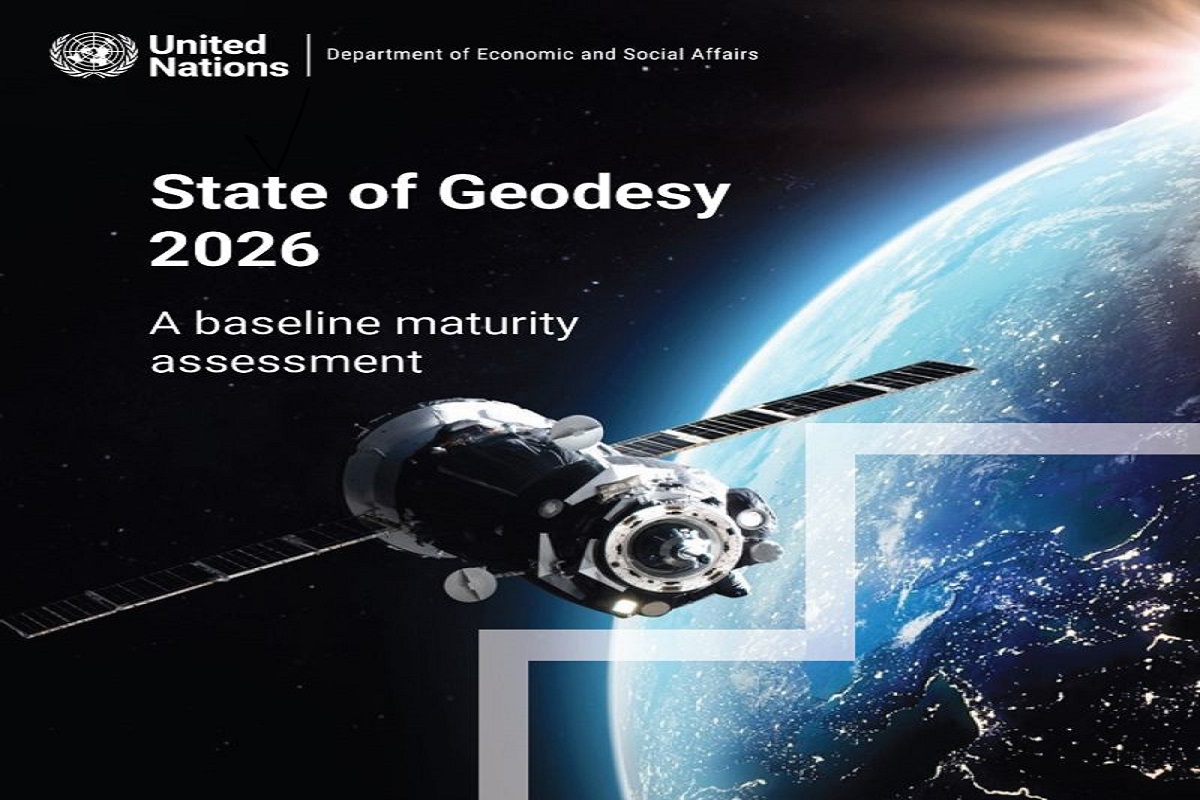
In March 2026, the UN Global Geodetic Centre of Excellence released State of Geodesy 2026 – A Baseline Maturity Assessment, the first comprehensive evaluation of the maturity of the Global Geodesy Supply Chain (GGSC).
The document marks an important milestone: for the first time, geodesy is examined as a global infrastructure, using an approach similar to that applied to power grids, telecommunications networks, or transportation systems.
The report begins with a simple but often overlooked fact: satellites do not operate independently. They require continuous updates on their own position and on the Earth’s position and orientation. As the document states, “satellites are reliant on constant updates about their place in space and the Earth’s place in space,” a sentence that captures how indispensable geodetic products have become for satellite navigation, telecommunications timing, financial system integrity, climate monitoring, and orbital management.
Geodesy has become an essential yet invisible part of modern life. Geodetic products underpin GNSS positioning, regulate timing across communication networks, support phase measurements in power grids, and enable the monitoring of phenomena such as land subsidence and sea‑level rise. It is no coincidence that, in 2024, GNSS providers publicly acknowledged that weaknesses in the GGSC pose a direct risk to the continuity of satellite services.
A system that works, but is not yet mature
The UN‑GGCE assessed 58 capabilities across six domains, resulting in an overall maturity score of 2.3 out of 5. This intermediate level indicates a system that functions but is not yet fully structured. Some components show high maturity: GNSS‑related capabilities score between 3.5 and 3.8 thanks to the robustness of the IGS network, while the DORIS system stands out with a score of 4.0. Calibration and maintenance procedures, particularly within IAG facilities, are also well established.
In contrast, governance and strategic functions represent the weakest area, with an average score of 1.8 and several capabilities rated at the lowest level. The report notes that the GGSC “operates and produces essential geodetic products,” but exhibits structural fragilities in coordination, planning, and sustainability. The most critical capabilities—international mandate, strategic planning, financial management, and risk management—are all rated at level 1. Global geodesy has historically developed as a voluntary scientific collaboration, without an international authority with operational power, and this model now shows clear limitations.
The consequences are tangible: the supply chain depends heavily on voluntary contributions from institutions and universities; some data centres represent genuine single points of failure; many VLBI and SLR stations are aging; technical expertise is often concentrated in a small number of senior specialists nearing retirement; and political awareness of geodesy’s role remains low. The report highlights that this situation raises questions about the long‑term resilience of the supply chain.
Despite these weaknesses, the GGSC continues to deliver high‑quality geodetic products thanks to the commitment of the international scientific community. IAG services—from IGS to IVS, ILRS, and IERS—ensure consolidated analysis processes and shared technical standards. However, the report stresses that this situation cannot be considered sustainable in the long term: the concentration of low scores in governance and financial management “raises questions about whether current structural arrangements provide adequate resilience.”
Future priorities
The document identifies six areas requiring further investigation: the overall architecture of the supply chain, physical and cyber security requirements, coordination among data centres, sustainability of geodetic software, workforce trends, and an economic assessment of required investments. These topics will demand greater involvement from governments and international organisations.
State of Geodesy 2026 represents a turning point: geodesy is finally analysed as a global infrastructure, with clear technical strengths but also structural weaknesses that can no longer be ignored. The challenge for the coming years will be to transform a system based on voluntary contributions into a true international infrastructure, equipped with governance, resources, and resilience appropriate to the critical role geodesy plays in modern society.
Source: UN‑GGCE, State of Geodesy 2026, https://ggim.un.org/UNGGCE/documents/Stateofgeodesy.pdf