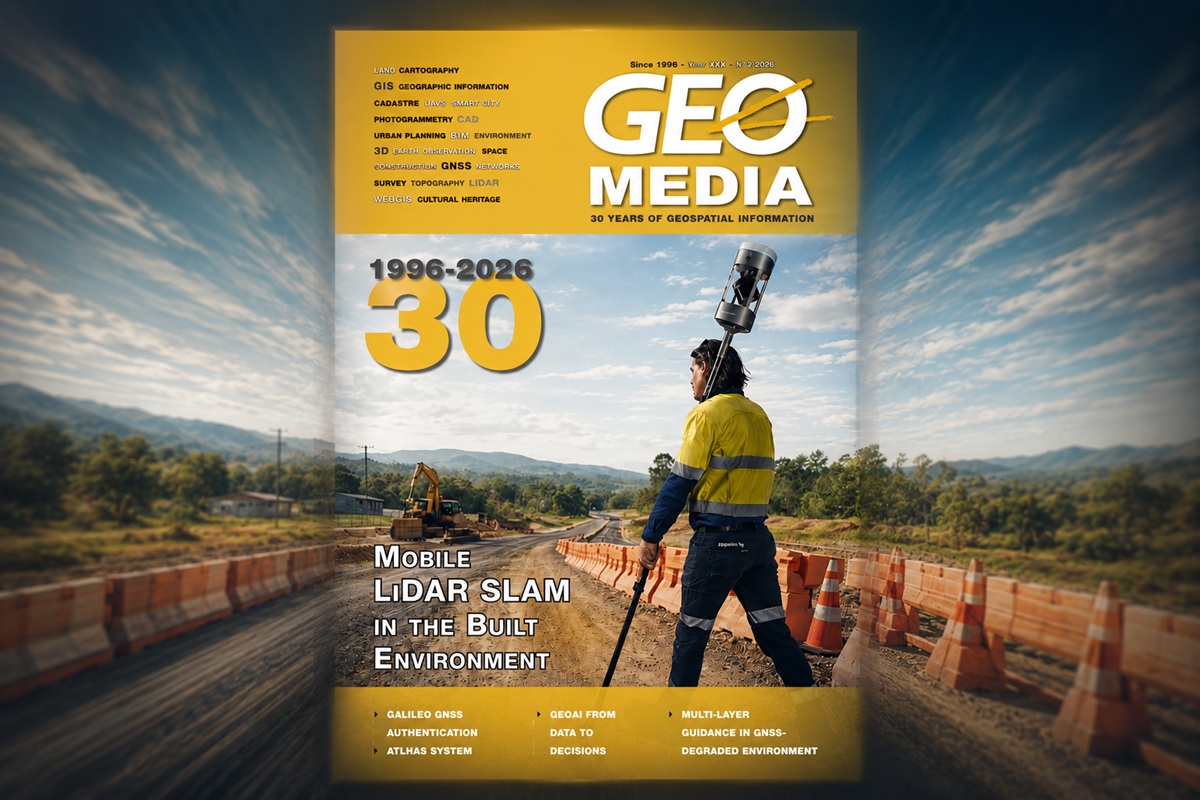
GEOmedia 2/2026 is now available, marking the second issue of the magazine's 30th anniversary year and bringing together contributions that explore some of the most dynamic developments in geomatics, positioning technologies, 3D reality capture, artificial intelligence, and trusted geospatial information.
The cover story, “Beyond the Tripod: Mobile LiDAR SLAM in the Built Environment” by Stuart Hill, examines how SLAM-based mobile mapping systems are reshaping surveying workflows, enabling rapid and highly efficient 3D data acquisition in complex construction and infrastructure environments.
As highlighted in the editorial, the geospatial sector is experiencing an unprecedented expansion in the availability and quality of digital information. Yet this abundance of data raises an increasingly important question: how can we trust what we see, measure and share? In a world where digital information can be easily manipulated or taken out of context, the value of geospatial data depends not only on accuracy, but also on authenticity, traceability and verifiability.
This theme is explored in the Focus article “Digital Data Spatial-Temporally Certified via Galileo GNSS Authentication: The ATLHAS System”, where Michele Donatacci, Gabriele Amendola, Luca Amendola, Jaume Cunill and Livio Rossi present an innovative approach for linking digital information to authenticated position and time references through Galileo, EGNOS and cryptographic technologies.
The issue also features contributions dedicated to GeoAI and decision-making processes, resilient GNSS navigation in degraded environments, GIS leadership, advanced remote sensing applications, historical cartography, and the latest generation of survey-grade mobile LiDAR systems.
Thirty years after its first publication, GEOmedia continues to explore how geomatics is evolving from a discipline focused on measuring and representing reality into one increasingly responsible for supporting trusted digital ecosystems and evidence-based decisions.
Focus
Leveraging Remote Sensing and GIS in 3D Modeling of a River Section for Sandbar Assessment: The Case of the Mbam River in Cameroon
Frédéric Laurent Esse Esse, Blaise Ngwem Bayiha, Philippes Mbevo Fendoung, Yota Manfouo Kerena, Moussa Sali, Emmanuel Yamb Bell
pp. 6–16
Digital Data Spatial-Temporally Certified via Galileo GNSS Authentication: The ATLHAS System
by Michele Donatacci, Gabriele Amendola, Luca Amendola, Jaume Cunill, Livio Rossi
pp. 18–21
Output
Beyond the Tripod: Mobile LiDAR SLAM in the Built Environment
by Stuart Hill
pp. 22–29
Report
From Map Person to Information Leader in GIS
by Izabela Miller
pp. 30–35
Artec 3D Launches Artec Jet: A Survey-Grade Mobile LiDAR Scanner with SLAM for Fast, Autonomous, Site-Scale 3D Mapping
Paul Hanapy
pp. 36–39
From Data to Decisions: Building a Practical Path to GeoAI
Dan Gruidel
pp. 40–43
Oreshnik IRBM: A Case Study in Resilient Multi-Layer Guidance Architecture Combining INS and GLONASS Corrections in GNSS-Degraded Environment
Marco Lisi
pp. 44–45
Columns
The Italian Airphoto Archive – War Cartography and John Brian Ward-Perkins's Archaeological Legacy: New Perspectives
Lucas Goudard
pp. 46–51
Agenda
pp. 52–56
ADV Index
- INTERGEO 2026 (p. 2)
- CGR (p. 15)
- Artec 3D (p. 17)
- ATLHAS (p. 21)
- Gter (p. 26)
- Epsilon Italia (p. 27)
- NV5 (p. 35)
- Global Mapper (p. 39)
- Esri Italia (p. 43)
- Stonex (p. 51)
- Teorema (p. 52)
- ISPRS 2026 (p. 53)
- UAV Expo (p. 54)
- Planetek Italia (p. 55)
- Emesent (p. 56)
As part of GEOmedia’s international dissemination programme, this issue will be distributed in a significant number of copies at leading industry events, including the ISPRS Congress 2026, INTERGEO 2026, RemTech Expo 2026, SAIE 2026, and ASITA 2026. These events represent important opportunities to promote research, innovation and best practices across the global geomatics, Earth observation, surveying, digital construction and geospatial communities, while ensuring broad visibility for the contributions published in this edition.
Links:
- Browse the digital edition
- Subscribe to GEOmedia and download PDF issues
- Individual articles will be progressively published in Open Access through the OJS Platform