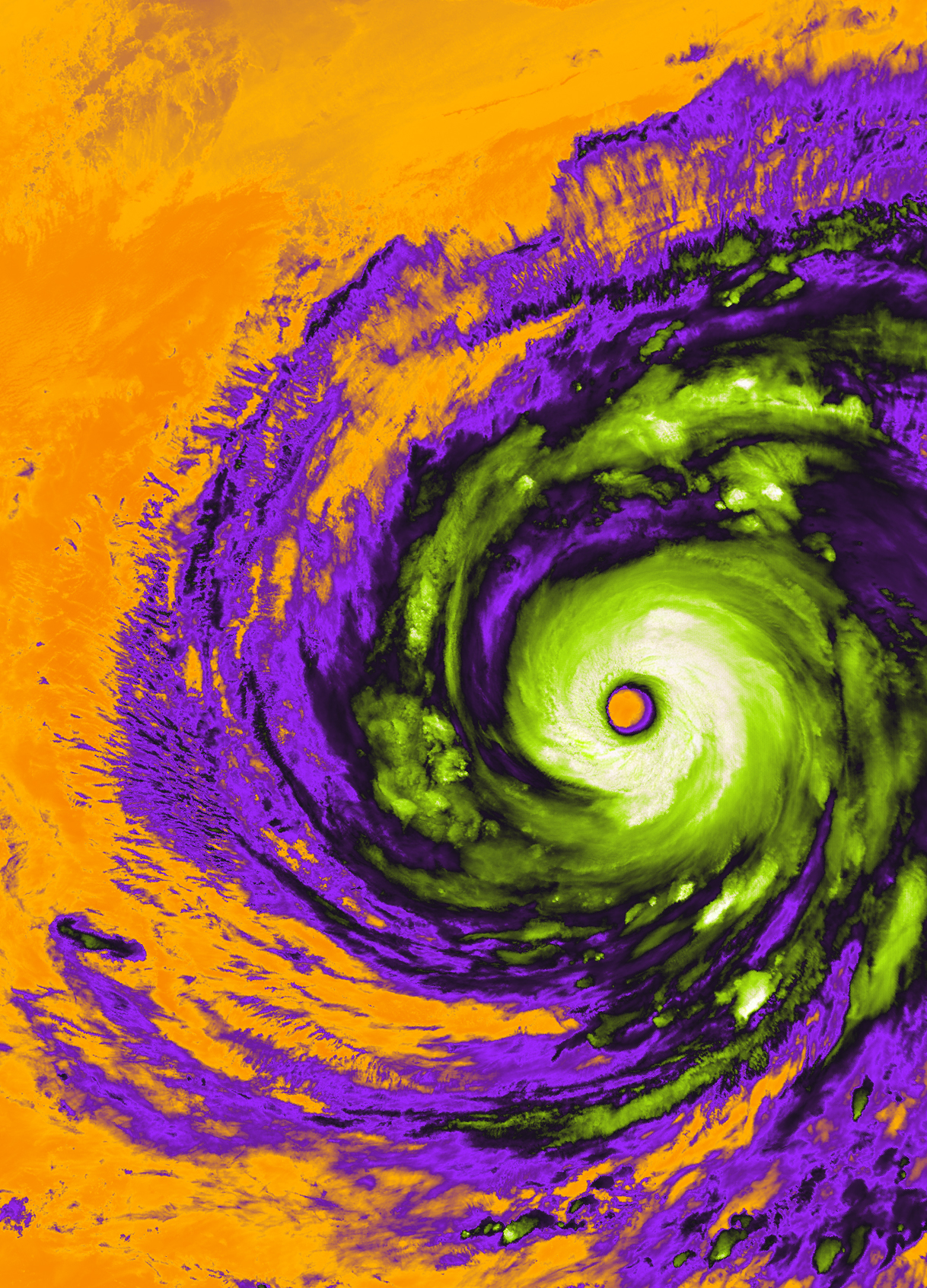
Questa settimana la vista della Terra dallo spazio è un'immagine del super tifone Champi ottenuta da Copernicus Sentinel-3 il 21 ottobre 2026 e ripresa al largo delle coste di Taiwan e delle Filippine.
Questa immagine a falsi colori offre un vivido ritratto dell'occhio di questa tempesta mostruosa, che si estende per circa 50 km di diametro. La tempesta è rappresentata in colori che ricordano quelli dei ‘ghoul’, le zucche e le streghe associate ad Halloween.
Champi è il ciclone tropicale più forte registrato finora quest'anno, con venti che hanno raggiunto la velocità massima di 296 km/h. Il sensore ‘Sea and Land Surface Temperature Radiometer’ a bordo di Sentinel-3 ha catturato le sommità delle nuvole, la superficie del mare e parte della superficie terrestre sul lato sinistro.
Lo strumento a bordo del satellite misura la radianza nelle lunghezze d'onda dell’infrarosso termico. La radianza termica viene utilizzata per dedurre la temperatura di brillanza, che può differire dalla temperatura effettiva.
In questa immagine la temperatura di brillanza è stata assegnata a colori distinti per migliorare l'impatto visivo. Le aree di colore verde, bianco e grigio chiaro sono le nuvole fredde al centro della tempesta, dove le temperature sulla sommità delle nuvole scendono fino a -70 °C. Le aree viola sono anch'esse nuvole, però con un intervallo di temperatura tra -30 °C e -15 °C. Le aree arancioni sono temperature rilevate sia su oceano che sulla terraferma e sono in media intorno ai 25 °C.
La causa del tifone – le nuvole fredde che si muovono sopra l'oceano caldo – è chiaramente descritta in questa immagine. La potente tempesta ha causato gravi alluvioni e danni nell'est di Taiwan e vicino al centro della tempesta ha originato onde fino a 10 m di altezza.
Scarica immagine Hi-Res (2,31 MB - .JPG)
---
Champi’s eerie eye
This week’s Earth from Space is an image of Super Typhoon Champi from Copernicus Sentinel-3, captured on 21 October 2026, and taken off the coasts of Taiwan and the Philippines.
This false-colour image paints a vivid portrait of the eye of this monster storm, which spans approximately 50 km across. The storm is shown in colours reminiscent of the ghouls, pumpkins and witches associated with Halloween.
Champi is the strongest tropical cyclone recorded so far this year, with maximum sustained winds of 296 km per hour. The Sea and Land Surface Temperature Radiometer on board Sentinel-3 captured the tops of clouds, sea surface and some land surface on the left-hand side.
The satellite’s instrument measures radiance in thermal infrared wavelengths. The thermal radiance is used to infer brightness temperature, which may differ from actual temperature.
In this image, the brightness temperature has been assigned to distinct colours for visual impact. The green, white and light grey areas are the cold clouds at the centre of the storm where cloud-top temperatures plummet as low as -70 °C. The purple areas are also clouds, with a temperature range between -30 °C to -15 °C. The orange areas are temperatures over both ocean and land, and are on average about 25 °C.
The cause of the typhoon – the cold clouds moving over the warm ocean – is clearly illustrated in this image. The powerful storm brought serious flooding and damage across eastern Taiwan and caused waves of up to 10 m near the storm’s centre.
[Credits: contains modified Copernicus Sentinel data (2026), processed by ESA - Translation: Gianluca Pititto]