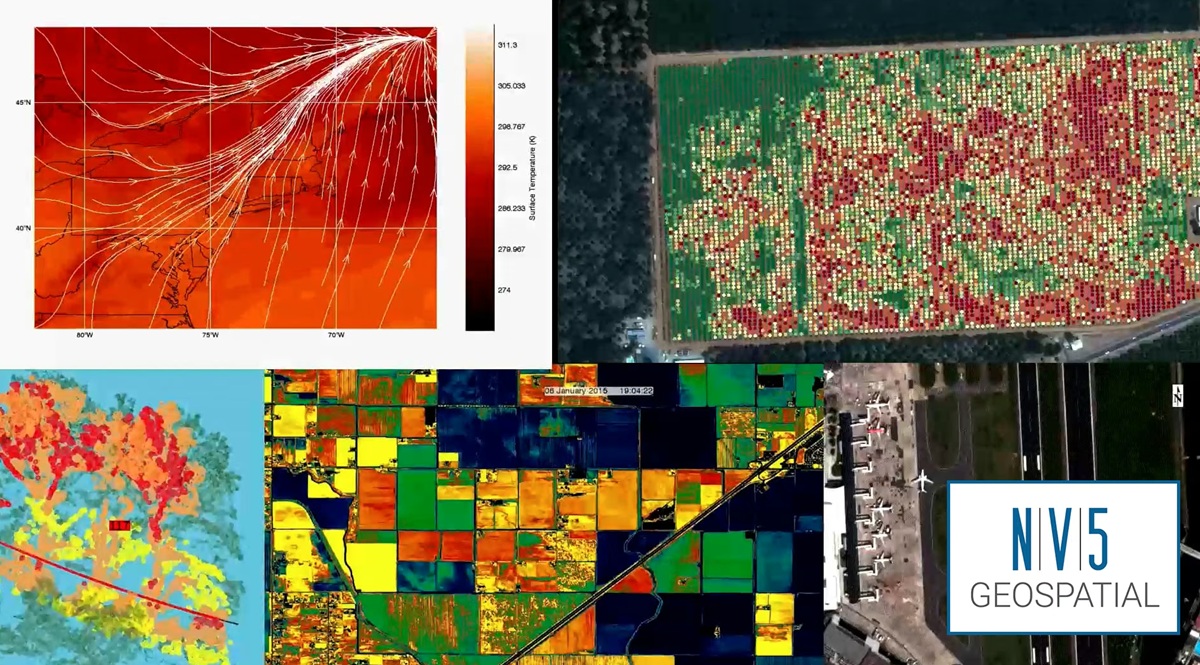
On October 14–15, Geo Sessions 2026 will bring together experts from industry, research and government to explore the changing landscape of geospatial data analysis. Organized by NV5, this year’s online event places particular emphasis on GeoAI, alongside SAR, spectral imaging and LiDAR. The underlying question is increasingly relevant for the geospatial community: how can artificial intelligence move from experimentation into reliable operational workflows?
From geospatial data to actionable information
Earth observation satellites, SAR, hyperspectral and multispectral sensors, LiDAR and drones are producing unprecedented amounts of information about the Earth. The challenge is increasingly shifting downstream: automatically identifying relevant features and changes, combining different sources and delivering results that can support real-world decisions. This is where GeoAI is becoming particularly significant. Machine learning and deep learning are already used for land-cover classification, object detection, feature extraction and change detection. The next step is to move these capabilities from successful demonstrations into reliable, scalable and repeatable operational workflows.
GEO SESSIONS 2026 — ONLINE EVENT
October 14–15, 2026
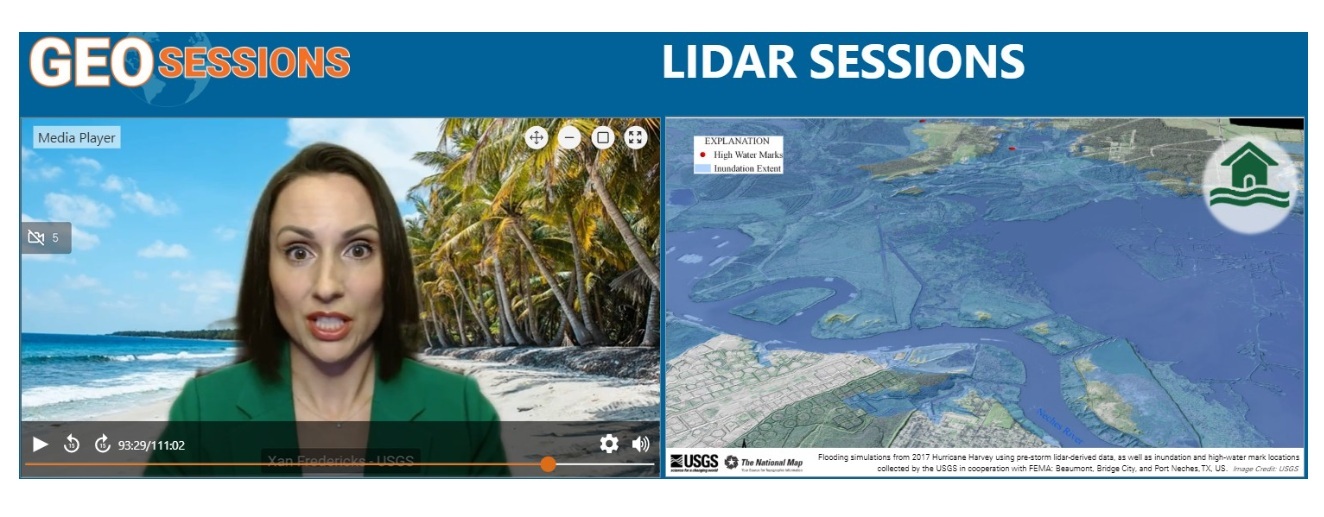
October 14: SAR and LiDAR
October 15: Spectral Imaging and GeoAI
View the full agenda and register
GeoAI meets SAR, LiDAR and spectral imaging
Geo Sessions 2026 reflects this evolution by bringing together four closely connected technological areas: SAR, spectral imaging, LiDAR and GeoAI. Their convergence points toward increasingly multimodal geospatial environments, where AI can help integrate observations from different sensors and extract information that would be difficult or time-consuming to identify manually. For the first time, the event includes a dedicated GeoAI track. Among the topics scheduled for October 15 are a panel on “How to Operationalize and Extract Benefits from GeoAI” and a presentation exploring the emerging concept of GeoAgents.
Operational AI still depends on trusted data
This transition also raises important questions about data quality, interoperability, validation and trust. AI can accelerate geospatial analysis, but the reliability of its results remains closely connected to the accuracy, consistency and provenance of the underlying geographic information. Rather than replacing geospatial expertise, GeoAI may therefore change where that expertise creates value. As feature extraction and classification become increasingly automated, professionals will play an even greater role in validating results, understanding uncertainty and translating automated analysis into informed decisions.
From experimentation to everyday workflows
The broader issue emerging from Geo Sessions 2026 is consequently not simply what AI can do with geospatial data, but how close the industry is to making GeoAI a trusted component of everyday operational workflows.
The integration of AI with SAR, LiDAR and spectral information suggests that the next step in geospatial innovation may be less about individual technologies and increasingly about connecting sensing, analysis and decision support within a single operational chain.
GEO SESSIONS 2026
October 14–15, 2026 | Online | Free registration